Graveyard Keeper 2 mastery: why a recipe will not start
Mastery decides whether a job starts, how fast it goes and how many stars it earns. Every source of points, and the quickest way to close a gap.
The short answer
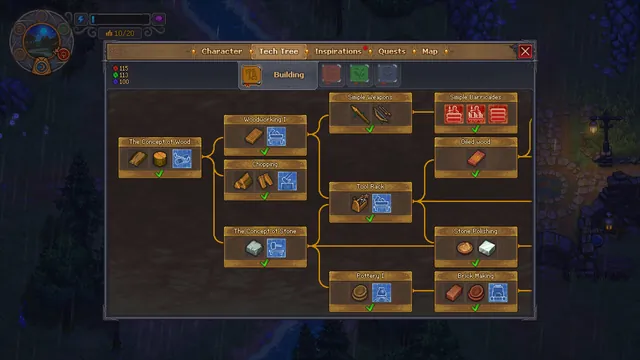
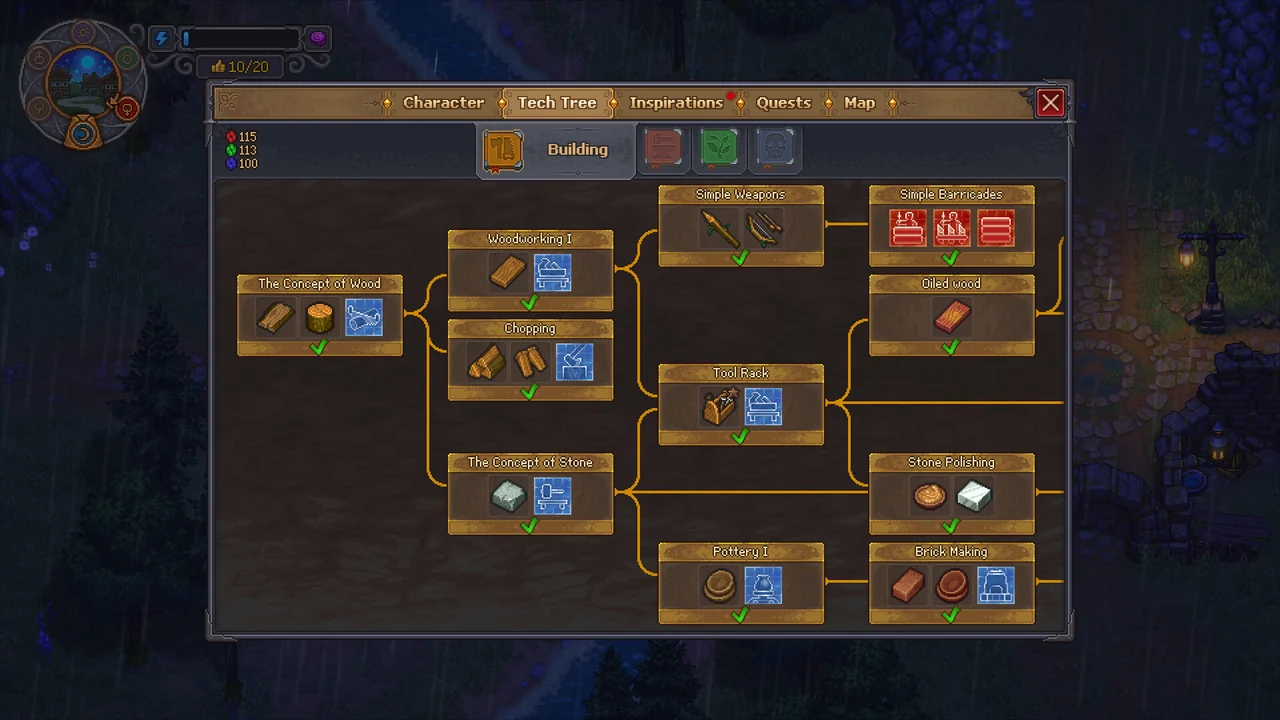
Each recipe asks for mastery in one of five branches: Building, Farming, Smithing, Book writing or Anatomy. You add it up from tools on your toolbar (rusty +1, bronze +2, iron +4, steel +6), mastery nodes in that branch’s talent tree, recipe-specific perks and short food buffs. Ordinary recipes refuse to start below the requirement. A better tool sitting in your backpack adds nothing.
 VIEW IMAGE ↗
What to check, in order
- 01
Hover the recipe and note the branch and the number it asks for.
- 02
Put the right tool types for that branch on your toolbar, not in the backpack.
- 03
Upgrade the weakest tool first; going from rusty to bronze doubles its bonus.
- 04
Claim inspirations and take the branch’s mastery node in the talent tree.
- 05
Eat the matching buff food just before a long session of that work.
- 06
If a zombie runs the bench, check the zombie’s own tool and talents instead of yours.
Diagnose a mastery gate
- 01
Recipe branch
Identify the required skill
- 02
Equipped tools
Toolbar, not just backpack
- 03
Talent bonus
Check active upgrades
- 04
Worker setup
A separate mastery total
Field Guide schematic · read alongside the checklist. Not an in-game screen.
The five branches and their tools
Every job in the game belongs to one branch, and each branch has its own tools. The tool you are visibly swinging is not the only one that counts: everything of the right kind on your toolbar adds its bonus, with one slot per tool kind. So for Building, your axe and your pickaxe both count, even while you are hammering a gravestone together.
A few surprises: the four old tree types count as Farming, not Building. Cooking and brewing live in Farming too. And the Study Table sits under Book writing, not Anatomy.
| Branch | Tools that add to it | Jobs it covers |
|---|---|---|
| Building | Axe, pickaxe | Felling, mining, clearing junk, carpentry, masonry, pottery |
| Farming | Shovel, fishing rod | Garden beds, cooking, brewing, stumps, bushes, fishing |
| Smithing | Hammer, small tools | Furnace, anvils, smithy, jewellery, glass |
| Book writing | Books, talismans | Writing desk, paper, printing, Study Table |
| Anatomy | Surgical kits, alchemist’s kits | Autopsy, embalming, alchemy, resurrection |
Where mastery points come from
The four sources stack, so a recipe that looks impossible is often two cheap changes away. Tools are the quickest lever. A bronze tool gives twice what a rusty one does, iron doubles it again, and steel adds +6.
Talents are the slow, permanent lever. Each branch starts at zero, and the first node in every branch is a +1 mastery node. Over the whole tree each branch has five mastery nodes, so for Anatomy the talent tree alone can reach +5.
Perks are narrow. They add mastery only for the specific recipes named on them, which is great when it is your bottleneck and useless otherwise.
| Tool material | Mastery bonus |
|---|---|
| Rusty | +1 |
| Bronze | +2 |
| Iron | +4 |
| Steel | +6 |
Food buffs for a quick boost
Several dishes add temporary mastery. The buff lasts 7.5 real minutes, which is one in-game day, so eat right before the session that needs it rather than first thing in the morning. Star grade matters for the dishes that come in grades: a three-star Vegetable Salad gives +3 Anatomy, a one-star gives +1.
| Dish | Branch | Bonus |
|---|---|---|
| Vegetable salad | Anatomy | +1 / +2 / +3 by star grade |
| Bowl of sauerkraut | Book writing | +1 to +3 by star grade |
| Muffin | Farming | +2 |
| Pumpkin soup | Building | +2 |
| Soldier’s stew | Smithing | +2 |
Field note: For autopsies, Third Eye Salt adds +2 Anatomy for 7.5 minutes and stacks with a salad. That combination is often what gets a heart or guts out cleanly.
What happens below the requirement
Ordinary recipes simply will not start. Autopsies and starred recipes behave differently: they start as long as you have at least 1 mastery in the branch, but each swing only succeeds with odds of roughly your mastery divided by the requirement. Misses still move the job along. They just cost you stars, or in an autopsy, the organ.
Garden work has its own small rules. Digging a fresh bed needs Farming 2, planting and casting a rod need Farming 1, and harvesting a ripe bed needs nothing at all. A rusty shovel only gives 1, so the very first bed often needs a bronze shovel or the first Farming node.
Extra mastery means faster, cheaper work
Meeting the requirement is the floor, not the ceiling. Each swing advances a job by your mastery divided by the requirement, rounded down and capped at 3 steps. With double the requirement you finish in half the swings, and since energy is charged per swing, you also spend half the energy.
That is the hidden reason to upgrade tools you can already work with. An iron axe on a recipe that asks for Building 2 takes a third of the swings a rusty axe needs.
A worked example: the autopsy that keeps failing
Say you want a clean heart. A grade 1 heart asks for Anatomy 5, and you are sitting at 1 from your first talent node. Every swing then succeeds about one time in five, which is how organs end up destroyed or replaced with a Surgeon’s Error.
Now stack the cheap sources. A Butcher’s Kit adds +1, a one-star Vegetable Salad another +1, and Third Eye Salt +2. That is 5, the full requirement, and every swing succeeds. Swap the Butcher’s Kit for a Surgeon’s Kit (+2) and you have room to spare.
The same thinking works for any branch. List what you have, list what the recipe wants, and fill the gap with the cheapest source first. Tools usually win, food is great for a one-off session, and talents are the long game. The very top autopsies, grade 3 hearts, guts and brains, ask for Anatomy 13, which needs every source stacked at once.
Zombie workers and the early gates
Workers bring their own mastery. A zombie uses its tool and its own talent tree and never borrows yours, so checking your keeper’s numbers for a stalled bench is a dead end. Inspect the zombie instead.
Two early gates catch almost everyone. Anatomy starts at zero, which blocks organ removal on your first bodies until you claim the Pickpocket and Last Respects inspirations. Building mastery 3 is needed for wood wedges and pieces of stone, so keep both the axe and the pickaxe on the toolbar and take the first Building node from the Lumberjack and Rock Breaker inspirations.
Common questions
Does a better tool in my backpack help?+
No. Only tools on the toolbar count, with one slot per tool kind.
Do zombie workers use my mastery?+
No. Zombies use their own tool and their own talent tree.
Why can I start an autopsy I do not meet the requirement for?+
Autopsies and starred recipes start with any mastery above zero, but every swing can fail. Below the requirement you risk losing the organ or getting a Surgeon’s Error.
How long do mastery food buffs last?+
7.5 real minutes, which is one in-game day.
Is it worth going above the requirement?+
Yes. Extra mastery means fewer swings and less energy per job, up to three steps per swing.
Why can I not dig my first garden bed?+
Digging needs Farming 2 and a rusty shovel only gives 1. Get a bronze shovel or the first Farming talent node.
Do two pickaxes on the toolbar count twice?+
No. There is one slot per tool kind, so a branch counts at most one of each kind, which in practice means two tools for Building (axe and pickaxe).
Sources & further reading
Recipes, costs and timings were cross-checked against the references below and the official patch notes. Numbers can shift with updates, so the in-game recipe window always has the final word.
- Community databaseGK2DB: mastery
- Community databaseGK2DB: corpses and organs (Anatomy bonuses)
- Community guideGK2DB: your first week
- Guidegames.gg: beginner tips (food buffs)